Cav1.2 Rabbit Polyclonal Antibody

货号: BD-PN5643
收藏
规格 价格 货期 数量
  • 50μl
    1100.00
    咨询
    100μl
    2000.00
    咨询

产品基本信息

  • 产品货号 BD-PN5643
  • 别名 Voltage-dependent L-type calcium channel subunit alpha-1C (Calcium channel, L type, alpha-1 polypeptide, isoform 1, cardiac muscle;Voltage-gated calcium channel subunit alpha Cav1.2)
  • 产品名称 Cav1.2 Rabbit Polyclonal Antibody
  • 类别 抗体产品
  • 基因名称 CACNA1C
  • 蛋白名称 Voltage-dependent L-type calcium channel subunit alpha-1C (Calcium channel, L type, alpha-1 polypeptide, isoform 1, cardiac muscle) (Voltage-gated calcium channel subunit alpha Cav1.2)
  • Clonality Polyclonal
  • 推荐应用 IHC-P,IF-P,IF-F,IF-ICC
  • 反应种属 Human,Rat,Mouse
  • 浓度 1 mg/ml
  • 存储缓冲液 Liquid in PBS containing 50% glycerol, 0.5% BSA and 0.02% New type preservative N.
  • Human Gene ID 775
  • Human Gene Link http://www.ncbi.nlm.nih.gov/sites/entrez?db=gene&term=775
  • Human Swissprot No. Q13936
  • Human Swissprot Link http://www.uniprot.org/uniprotkb/Q13936/entry
  • Mouse Swissprot No. Q01815
  • Mouse Swissprot Link http://www.uniprot.org/uniprot/Q01815
  • Rat Swissprot No. P22002
  • Rat Swissprot Link http://www.uniprot.org/uniprot/O54941P22002
  • 免疫原 Synthetic Peptide of Cav1.2
  • 特异性 Cav1.2 protein(A201) detects endogenous levels of Cav1.2
  • 稀释度 IHC-P 1:100-200, IF-P/IF-F/IF-ICC 1:50-200
  • 预测分子量 160-240kDa
  • 运输及保存条件 Biological ice bag transportation. Store at -20°C for at least 12 months(Do not lower than -25°C). Avoid freeze/thaw cycles
  • 宿主 Rabbit
  • 同种型 Rabbit,IgG
  • 背景介绍 calcium voltage-gated channel subunit alpha1 C(CACNA1C) Homo sapiens This gene encodes an alpha-1 subunit of a voltage-dependent calcium channel. Calcium channels mediate the influx of calcium ions into the cell upon membrane polarization. The alpha-1 subunit consists of 24 transmembrane segments and forms the pore through which ions pass into the cell. The calcium channel consists of a complex of alpha-1, alpha-2/delta, beta, and gamma subunits in a 1:1:1:1 ratio. There are multiple isoforms of each of these proteins, either encoded by different genes or the result of alternative splicing of transcripts. The protein encoded by this gene binds to and is inhibited by dihydropyridine. Alternative splicing results in many transcript variants encoding different proteins. Some of the predicted proteins may not produce functional ion channel subunits. [provided by RefSeq, Oct 2012],
  • 组织表达 Detected throughout the brain, including hippocampus, cerebellum and amygdala, throughout the heart and vascular system, including ductus arteriosus, in urinary bladder, and in retina and sclera in the eye (PubMed:15454078). Expressed in brain, heart, jejunum, ovary, pancreatic beta-cells and vascular smooth muscle. Overall expression is reduced in atherosclerotic vascular smooth muscle.
  • 细胞定位 Cell membrane ; Multi-pass membrane protein . Cell membrane, sarcolemma ; Multi-pass membrane protein . Perikaryon . Cell junction, synapse, postsynaptic density membrane . Cell projection, dendrite . Cell membrane, sarcolemma, T-tubule . Colocalizes with ryanodine receptors in distinct clusters at the junctional membrane, where the sarcolemma and the sarcoplasmic reticulum are in close contact. The interaction between RRAD and CACNB2 promotes the expression of CACNA1C at the cell membrane. .
  • 信号通路 MAPK_ERK_Growth;MAPK_G_Protein;Calcium;Cardiac muscle contraction;Vascular smooth muscle contraction;Long-term potentiation;GnRH;Type II diabetes mellitus;Alzheimer's disease;Hypertrophic cardiomyopathy (HCM);Arrhythmogenic right ventricular cardiomyopathy (ARVC);Dilated cardiomyopathy;
  • 功能 alternative products:Additional isoforms seem to exist. Exons 8A, 21, 22, 31, 32, 33, 40B, 43A, 41A and 45 are alternatively spliced in a variety of combinations. Experimental confirmation may be lacking for some isoforms,disease:Defects in CACNA1C are the cause of Brugada syndrome type 3 (BRS3) [MIM:611875]. BRS3 is a heart disease characterized by the association of Brugada syndrome with shortened QT intervals. Brugada syndrome is a tachyarrhythmia characterized by right bundle branch block and ST segment elevation on an electrocardiogram (ECG). It can cause the ventricles to beat so fast that the blood is prevented from circulating efficiently in the body. When this situation occurs (called ventricular fibrillation), the individual will faint and may die in a few minutes if the heart is not reset.,disease:Defects in CACNA1C are the cause of Timothy syndrome (TS) [MIM:601005]. TS is a disorder characterized by multiorgan dysfunction including lethal arrhythmias, webbing of fingers and toes, congenital heart disease, immune deficiency, intermittent hypoglycemia, cognitive abnormalities and autism.,domain:Binding of intracellular calcium through the EF-hand motif inhibits the opening of the channel.,domain:Each of the four internal repeats contains five hydrophobic transmembrane segments (S1, S2, S3, S5, S6) and one positively charged transmembrane segment (S4). S4 segments probably represent the voltage-sensor and are characterized by a series of positively charged amino acids at every third position.,function:Voltage-sensitive calcium channels (VSCC) mediate the entry of calcium ions into excitable cells and are also involved in a variety of calcium-dependent processes, including muscle contraction, hormone or neurotransmitter release, gene expression, cell motility, cell division and cell death. The isoform alpha-1C gives rise to L-type calcium currents. Long-lasting (L-type) calcium channels belong to the 'high-voltage activated' (HVA) group. They are blocked by dihydropyridines (DHP), phenylalkylamines, benzothiazepines, and by omega-agatoxin-IIIA (omega-Aga-IIIA). They are however insensitive to omega-conotoxin-GVIA (omega-CTx-GVIA) and omega-agatoxin-IVA (omega-Aga-IVA). Calcium channels containing the alpha-1C subunit play an important role in excitation-contraction coupling in the heart. The various isoforms display marked differences in the sensitivity to DHP compounds.,PTM:Phosphorylation by PKA activates the channel.,similarity:Belongs to the calcium channel alpha-1 subunit (TC 1.A.1.11) family.,subunit:Voltage-dependent calcium channels are multisubunit complexes, consisting of alpha-1, alpha-2, beta and delta subunits in a 1:1:1:1 ratio. The channel activity is directed by the pore-forming and voltage-sensitive alpha-1 subunit. In many cases, this subunit is sufficient to generate voltage-sensitive calcium channel activity. The auxiliary subunits beta and alpha-2/delta linked by a disulfide bridge regulate the channel activity. Interacts with CACNA2D4.,tissue specificity:Expressed in brain, heart, jejunum, ovary, pancreatic beta-cells and vascular smooth muscle. Overall expression is reduced in atherosclerotic vascular smooth muscle.,
  • 纯化 The antibody was affinity-purified from rabbit antiserum by affinity-chromatography using epitope-specific immunogen.

图片

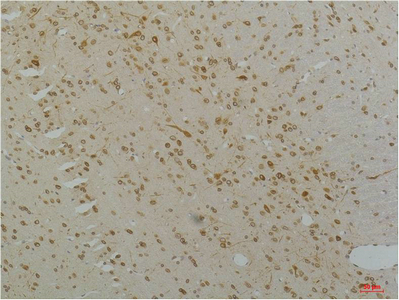
Immunohistochemical analysis of paraffin-embedded Rat Brain Tissue using Cav1.2Rabbit pAb diluted at 1:200.
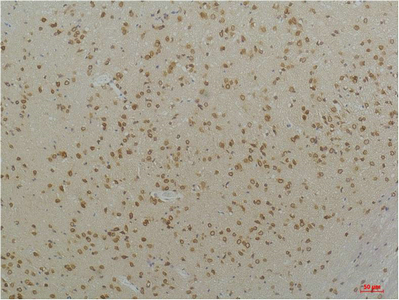
Immunohistochemical analysis of paraffin-embedded Mouse Brain Tissue using Cav1.2Rabbit pAb diluted at 1:200.

产品详情

文献引用 (0)

产品问答

内容已折叠

相关产品

内容已折叠

最新浏览的产品

评论内容:
上传图片:
商品评价:
提交评论
« »